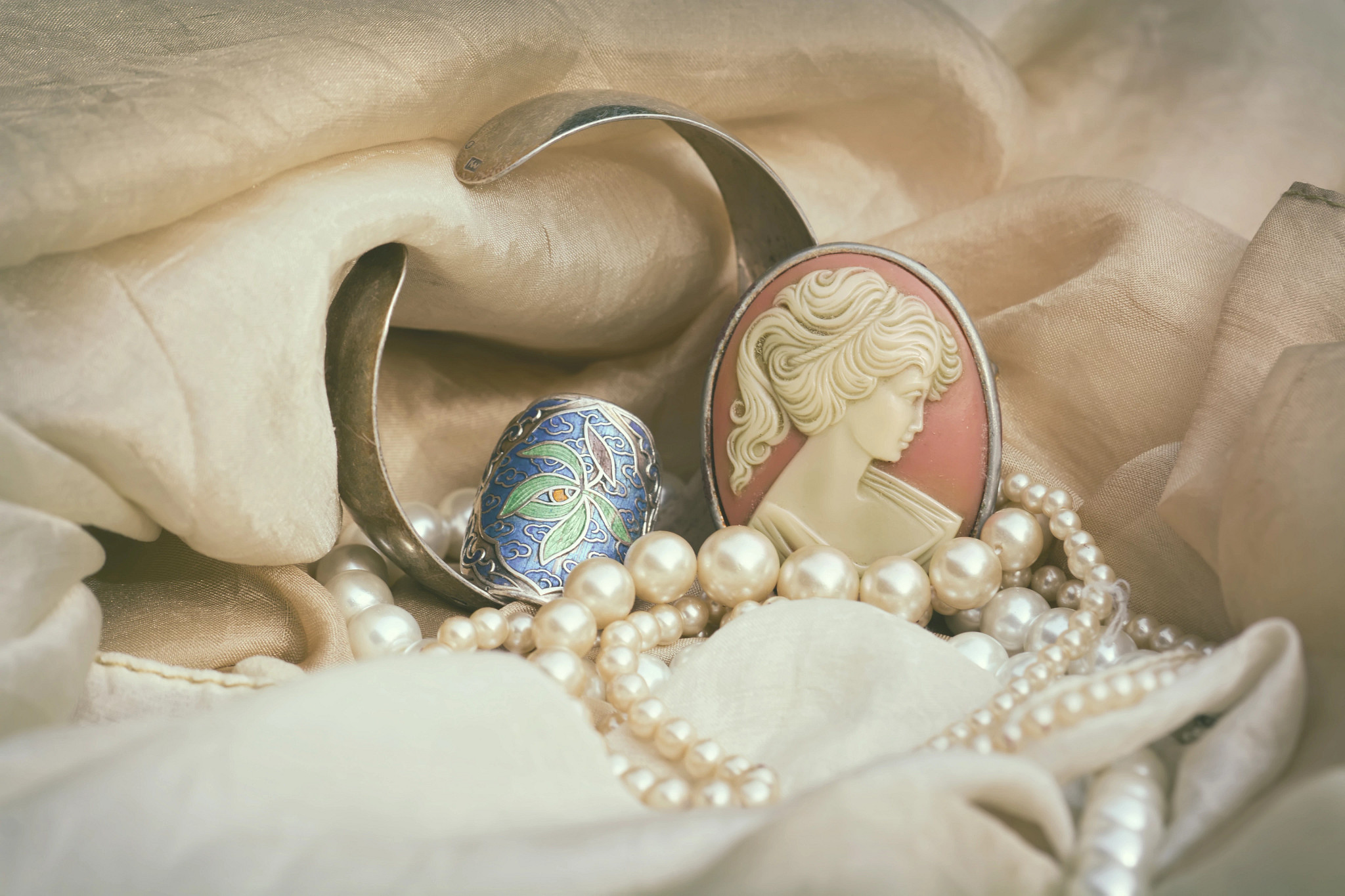
From the delicate beaded borders of milgrain to the airy, lace-like threads of filigree, certain jewelry-making methods helped define elegance throughout jewelry’s long history. These techniques decorate jewelry and add texture and three-dimensional depth, bringing life to flat jewelry surfaces. Granulation belongs to this elite family of ancient skills, offering detail that somehow feels very modern, yet classic at the same time. Whether you’re looking to add a unique piece of jewelry to your collection or are simply a connoisseur of beautiful jewelry-making techniques, here’s what you need to know.
What is granulation?
Granulation is a decorative technique where a goldsmith attaches tiny spheres of precious metal, known as granules, to a surface to create intricate patterns or textures. While it might look like simple soldering, true gold granulation is more complex, relying on a delicate balance of heat and chemistry to join the spheres without melting them. This method allows for dense, raised designs that catch the light from every angle, giving the metal a shimmering, beaded appearance. Because each tiny grain must be positioned by hand, creating granulation jewelry requires a high level of craftsmanship—and patience.
The history of granulation
The art of metal granulation dates back more than 5,000 years, with some of the earliest examples found in Mesopotamian and Egyptian tombs. However, it was the Etruscans between the 7th and 5th centuries BCE who perfected the technique, creating breathtakingly intricate designs that modern jewelers still strive to replicate today. While the method saw a decline in popularity during the Middle Ages, it experienced a major revival in the 19th century during the Archaeological Revival period, as Victorian jewelry makers drew inspiration from more ancient styles. Granulation jewelry is still all around, seen as a staple for high-end jewelry makers, goldsmiths and really anyone who enjoys handcrafted jewelry techniques over mass-produced ones.
The science behind how granulation works
The science behind how granulation works is essentially molecular bonding. Unlike traditional soldering, which uses a filler metal with a lower melting point to join parts, true granulation uses a technique called colloidal soldering. In this process, a copper-based glue chemically reacts with the gold surface. This reaction causes the two metals to fuse at a temperature lower than their individual melting points. When the jeweler hits the precise temperature, a microscopic weld forms, fusing the granule to the base without destroying its perfect sphere shape.
The granulation process: a step-by-step tutorial
Granulation is an intricate process that requires extreme precision and mastery of heat control. Let’s walk through the journey from raw metal to finished masterpiece.
Essential tools and materials checklist
Before beginning, a goldsmith needs high-karat gold (typically 18k or higher, as the purity affects the bonding process), a charcoal block for heat reflection, organic glue that disappears after soldering, fine-tipped brushes and a copper solution.
Phase 1: creating uniform gold granules
The process begins by cutting tiny, equal lengths of gold wire and placing them on a charcoal block. When heated with a torch, the gold naturally pulls into a perfect sphere due to surface tension. These granules are then cleaned and sorted by size to make sure the final pattern is symmetrical and professional.
Phase 2: preparing the base and applying the design
The jeweler begins by painting a thin layer of diluted glue and copper solution onto the gold surface, which acts as a temporary tack for the design. Then comes the most painstaking part: using a single-hair brush or a tiny needle, the jeweler picks up each gold sphere one by one and carefully places it onto the sticky gold surface. Depending on the size of the piece being created, it can take quite some time to nudge hundreds of tiny beads into perfect alignment to create the intricate swirls and patterns that make granulation jewelry so iconic.
Phase 3: the firing process
This stage can be a bit nerve-wracking. The piece is heated uniformly until the glue burns away and the copper triggers the eutectic bond. The jeweler watches for a specific flash of light, which is a sign that the surfaces have fused. If the temperature goes a few degrees too high, the granules will melt into the base, destroying the texture.
Phase 4: finishing and polishing
Once fused, the piece is dipped in a pickling solution to remove oxidation and then carefully polished. Because of the tiny crevices between the spheres, cleaning can prove to be a delicate task. If you’re dealing with an heirloom granulation jewelry piece, follow the tips for cleaning antique jewelry, including using a soft-bristle brush to reach between the granules.
Common granulation challenges and solutions
The most frequent hurdle in granulation techniques is flooding, where too much solder or heat causes the granules to merge into a single blob. Or, insufficient heat can lead to a weak bond, causing the tiny beads to fall off during wear. Expert jewelers solve this by using kiln-firing for more consistent temperatures or by using a reduction flame to prevent the gold from oxidizing before the bond can form.
Iconic examples of granulation in jewelry history
Throughout the history of jewelry, granulation has graced the world’s most prestigious collections. Perhaps the most breathtaking examples are the Nimrud Treasures, discovered in the 8th-century BCE tombs of Neo-Assyrian queens. These royal ornaments feature hundreds of microscopic gold spheres fused into floral and geometric patterns that have remained intact for nearly 3,000 years.
Other iconic examples include the incredibly detailed Etruscan “Pulviscolo” (dust-like granulation) pieces held in the Vatican Museums, which helped inspire a massive jewelry revival in the 19th century. In the modern era, many designers have brought this ancient texture back to the forefront of luxury, proving these tiny golden spheres are quite timeless.
Protect your valuable jewelry with Jewelers Mutual
Protect your valuable jewelry with a personal insurance policy from Jewelers Mutual. Coverage protects against loss, damage, theft and disappearance. Click the link below to check your rate.