You’ve heard the saying, “What’s old is new again,” especially when it comes to trends circling back into the spotlight. The same holds for nuummite, a remarkable mineral believed to be one of the oldest on Earth. With its dark, shimmering flashes and reputation as a mystical stone, nuummite has become increasingly popular among jewelry lovers and metaphysical healers. Read on to explore nuummite’s meaning, its metaphysical properties, benefits and how to tell if nuummite is real. You’ll also learn how to care for your nuummite jewelry, so it stays as beautiful as the day you found it.
What is nuummite?
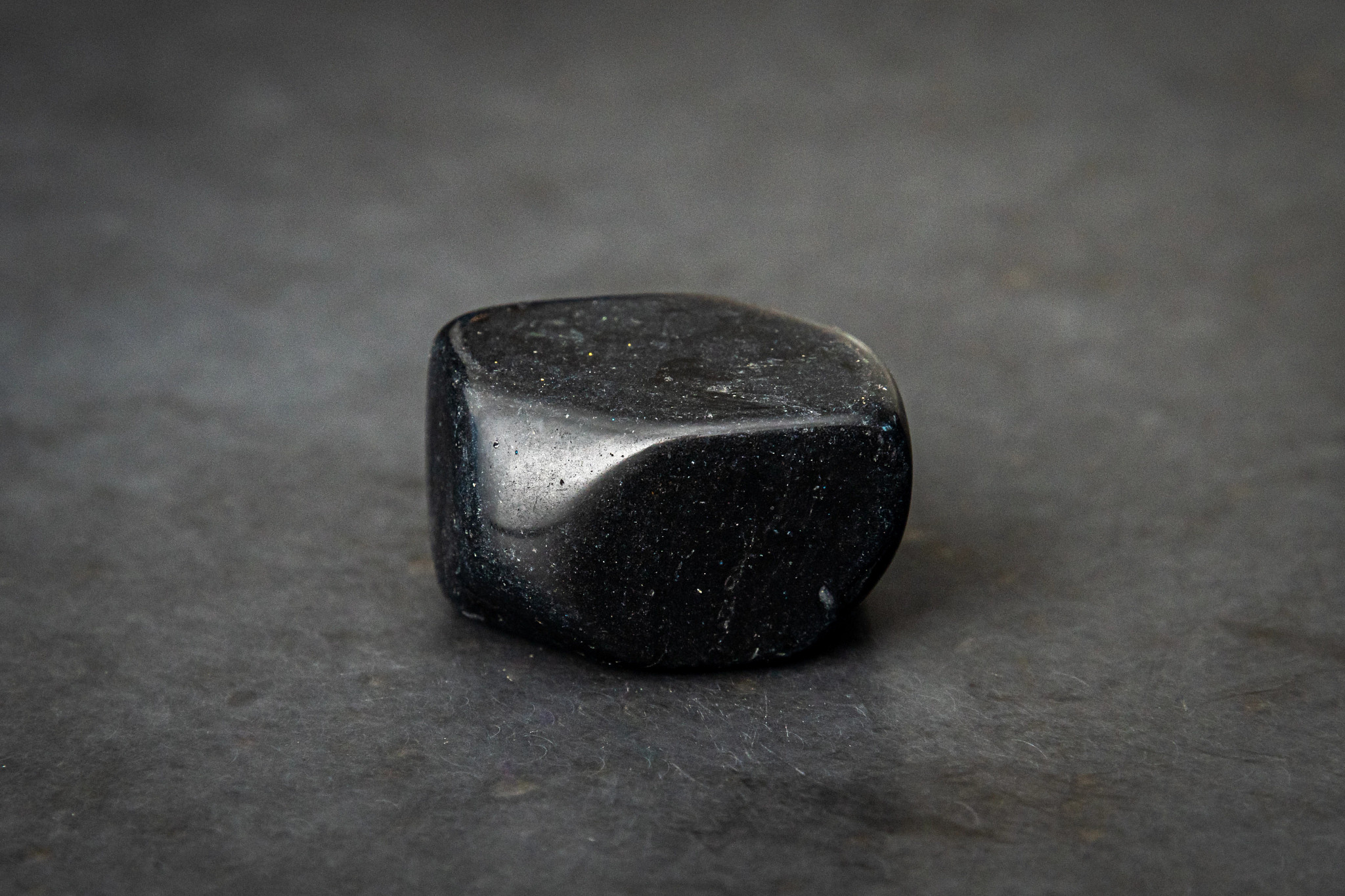
Nuummite is a rare metamorphic stone formed when ancient volcanic rocks were subjected to intense heat and pressure, transforming them into a dark, dense rock streaked with iridescent minerals. It is composed primarily of anthophyllite, a dark, fibrous mineral, and gedrite, a layered, needle-like mineral.
Mineralogist K. L. Giesecke first identified Nuummite in 1810 near Nuuk, Greenland, and it was later confirmed through radiometric dating to be more than three billion years old. This instantly placed nuummite among the oldest known minerals on Earth. Its extreme age is determined by analyzing the decay of isotopes within the rock, allowing geologists to calculate when the original material first solidified. For perspective, Colombian emeralds formed roughly 50 to 65 million years ago.
Throughout history, nuummite has been appreciated and used for its relative durability (ranking 5.5 to 6 on the Mohs hardness scale) and distinctive, shimmering look. These qualities make it well-suited for jewelry like pendants, rings and polished cabochons (non-faceted gemstones) that show off its natural flashes without risking structural damage.
How and where nuummite stone forms
Since its discovery over 200 years ago, only a few small deposits of nuummite have been found outside Greenland. These rare findings include the Yukon River in Canada, Converse County, Wyoming and Kainuu, Finland. Nuummite begins as ancient volcanic rock that is transformed over billions of years through intense heat and pressure. This process causes minerals to align and form layers, giving the stone its characteristic dark base and shimmering flashes. Thin, reflective mineral layers called lamellae develop within these layers and interact with light to produce the stone’s signature iridescent shimmer. Skilled jewelers carefully position and cut the stone to showcase these flashes, making nuummite the perfect gemstone for unique pieces that highlight natural beauty.
Nuummite stone characteristics
Nuummite is best known for its deep black base color, accented by streaks of iridescent gold, bronze, or blue. Each piece of nuummite displays a unique pattern of flashes, often called labradorescence. The shimmering bands of color within make it appear as though you can see deep inside the stone. In terms of jewelry, nuummite and its signature flickers can add a sense of movement to rings, pendants and bold statement pieces. Even simple nuummite settings can be eye-catching and dramatic. If you want a jewelry piece that stands out and holds up to regular wear, nuummite deserves a look!
Nuummite meaning and properties
Nuummite is often associated with themes of ancient wisdom, transformation and personal empowerment, largely because of its extreme age and distinctive depth of color. Many people view nuummite as a stone that symbolizes grounding and inner resilience, a popular choice for those seeking introspection or protection.
In spiritual and energy-focused communities, nuummite is believed to help uncover subconscious patterns, strengthen intuition and support emotional healing. Some individuals use it during meditation to enhance focus or connect with deeper layers of self-awareness. Nuummite is also commonly regarded as a protective stone, thought to help shield one’s energy and encourage stability. While these interpretations aren’t scientifically proven, their symbolic and energetic meanings are quite strong.
Difference between nuummite and other stones
Compared to other colored gemstones, nuummite stands out for its extreme age and its distinct, shimmering flashes created by interlocking minerals. While many dark stones exist, few display the same layered iridescence with such a dramatic, multidirectional sheen. Nuummite is often compared to labradorite because both stones show vibrant flashes. However, labradorite typically has larger, more colorful planes of color, whereas nuummite’s iridescence appears as finer streaks or flame-like bands.
Nuummite also resembles astrophyllite with its metallic sheen. However, astrophyllite tends to form star-shaped patterns and is softer, making it less suitable for certain jewelry pieces. Another stone sometimes mentioned alongside nuummite is black obsidian. However, obsidian is volcanic glass with a smooth, uniform appearance. It doesn’t have that fibrous, reflective structure that gives nuummite its signature look. Stones like arfvedsonite (a dark, slightly metallic mineral) may show shine, but their flashes are usually broader and less linear (a subtle but key differentiator!).
How to tell if nuummite is real
Authentic nuummite is rare and mainly sourced from Greenland, which may make you wonder, “How exactly do I tell if nuummite is real or not?” And it’s a very valid question, since so many look-alikes exist. For starters, authentic nuummite feels dense and shows fine interlocking crystal fibers under magnification. If a stone looks glassy or coated, it’s likely an imitation. Nuummite’s layers are multidirectional, not uniform. Beyond examining the stone, sellers will often note nuummite’s Greenland origin or provide lab verification, which is especially important for higher-value pieces. For added confidence, consider requesting a gemstone certification report to confirm authenticity and protect your investment.
How to care for your nuummite jewelry
Properly handling, cleaning and storing your jewelry can help keep it looking fresh.
- Nuummite jewelry should be stored separately from harder gemstones to prevent surface scratches, as its fibrous structure can be prone to abrasion.
- Clean the nuummite gently with lukewarm water, a mild soap, and a soft cloth, and avoid harsh chemicals or ultrasonic cleaners, which may damage the stone or loosen its natural fibers.
- Because nuummite can react to sudden temperature changes, it’s best to remove it before activities that involve extreme heat or cold, such as cooking with a hot oven, bathing, or washing dishes in very hot water, or skiing in freezing conditions.
- When wearing nuummite rings or bracelets, be mindful of hard knocks against surfaces, as repeated impact can cause damage or dull their polish over time.
Protect your valuable jewelry with Jewelers Mutual
If you own valuable jewelry, protecting it with a dedicated jewelry insurance policy is a smart choice. A personal jewelry policy from Jewelers Mutual offers coverage for loss, theft, damage and disappearance, some of which homeowners insurance plans may not cover. Click the link below to check your rate for coverage today.