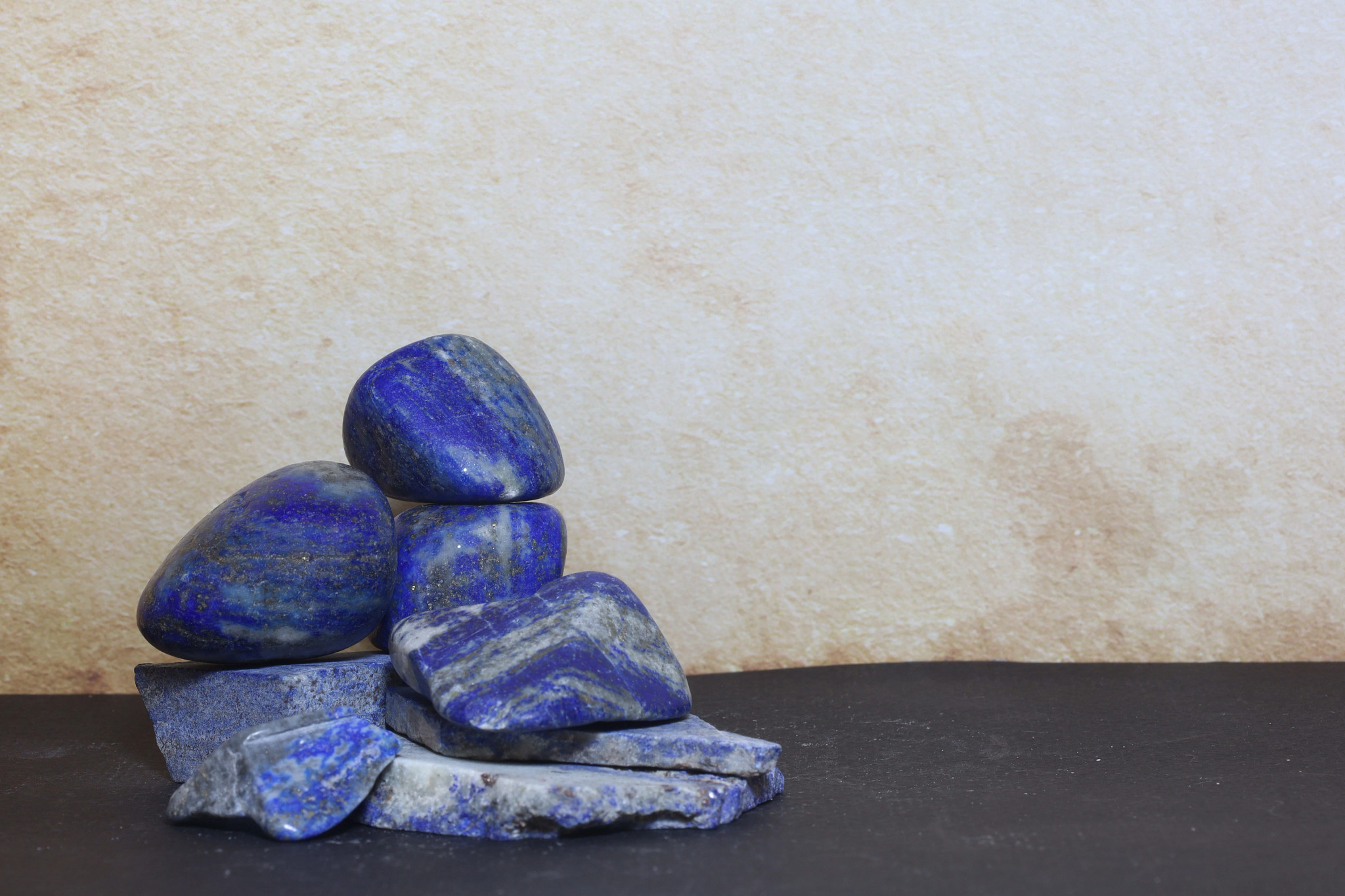
Over 13,000 years ago, powerful volcanic eruptions in the Eifel Mountains of western Germany and in central Italy blanketed the landscape with molten rock, ash and pumice. As the lava cooled and hardened, tiny blue crystals formed within the volcanic debris. These vivid, electric-blue specimens seemed to glow from within yet remained buried for thousands of years. When they were finally discovered in the early 1800s, they were identified as hauyne, a mineral and gemstone so rare that it’s found more often in private collections and museum displays than in everyday jewelry. Keep reading to uncover the secrets behind hauyne’s origins, properties, value and how to care for this volcanic treasure.
What is the hauyne stone?
Hauyne (pronounced ah-WEEN) is a rare mineral born from alkaline volcanic rock. It belongs to the same mineral family as sodalite, the material responsible for the iconic blue color in lapis lazuli, but hauyne itself is far scarcer and typically occurs only in small crystals. Gem-quality hauyne is sourced in just a few locations worldwide, with the most prized transparent blue stones coming from the Laacher See volcanic area in Germany’s Eifel region. Smaller deposits can be found in Italy, Afghanistan, Tanzania, Myanmar, Morocco and the Canary Islands, and in parts of the United States, including New York, Montana and Colorado, though many specimens are too small to cut.
Hauyne characteristics and properties
Hauyne is valued for its intensely saturated blue color, caused by sulfur trapped within its crystal structure, a trait shared by only a few minerals worldwide. Its signature ultramarine hue can range from medium to deep blue, and the stone may appear transparent, translucent or opaque, with a glassy or waxy luster. Some specimens fluoresce orange to pink under ultraviolet light. Although hauyne occurs in a surprising range of colors, including white, gray, green, yellow, red and pink, most are not gem-quality. One notable exception is a rare yellow-green hauyne discovered in Tanzania in 2003. Hauyne ranks 5.5-6 on the Mohs hardness scale, making it relatively soft compared to other gemstones. Its perfect cleavage, natural inclusions, fractures and generally small crystal size (usually under a carat) make it challenging to cut and facet, often requiring protective settings such as bezels. For these reasons, top-quality faceted hauyne is typically found only in private collections, museum exhibits, or select high-end or specialty jewelry shops.
The history of hauyne
Hauyne lay hidden in volcanic rock for centuries until the early 1800s. In 1802, Italian mineralogist Carlo Giuseppe Gismondi discovered vibrant blue crystals near Lake Nemi and referred to them as latialite. A few years later, in 1807, Danish mineralogist Tønnes Christian Bruun Neergaard examined similar crystals from Monte Somma near Naples and formally identified them as a new mineral. He named it hauyne, in honor of French crystallographer René Just Haüy, whose groundbreaking work helped establish the science of crystallography.
As mineral exploration continued, hauyne was also found in other volcanic regions, most notably in Germany's Eifel Mountain region, near the Laacher See volcano, which remains the most celebrated source of gem-quality material today. Smaller occurrences were later documented in parts of Italy, Afghanistan, and other volcanic areas around the world.
Because large, clean crystals suitable for faceting are exceptionally rare, hauyne never developed a long history of use in jewelry or became a staple in the way colored gems like sapphires or emeralds did.
Hauyne vs. lazurite
Hauyne and lazurite may look like twins at first glance. Both are stunning blue stones and members of the same sodalite family, but slight variations in color and structure set them apart. Lazurite, the main mineral in lapis lazuli, displays a cobalt-to-royal-blue hue with tiny flecks of white or gold. Hauyne gemstones, by contrast, have a brighter, more saturated blue, without speckles, that can range from opaque to transparent, giving the stone a subtle inner glow. The two also differ chemically. Hauyne is rich in sulfate, while lazurite is a sodium-calcium-aluminum silicate. These differences influence how the stones form, how they handle cutting and how they appear in jewelry. Lazurite often forms in larger, opaque pieces that are easy to shape into cabochons or beads, which is why it’s widely used in necklaces, bracelets, and decorative objects. Hauyne is usually found in smaller, more delicate forms and often includes crystals, which is why it’s used more selectively in jewelry by independent jewelers, specialty designers, or gemstone dealers.
Is hauyne valuable?
Yes, hauyne can be very valuable, especially in jewelry. Its value comes down to several key factors:
- Color: The most sought-after hauyne shows an intensely saturated ultramarine blue. In high-quality stones, this blue can look so vivid and pure that it’s sometimes mistaken for a synthetic gem, simply because natural stones with such color are extremely rare.
- Clarity: Transparent or eye-clean hauyne is extremely rare and commands premium prices. Opaque stones are easier to find and commonly cut as smooth cabochons.
- Size: Larger crystals suitable for faceted jewelry are very uncommon. Most gem-quality hauyne weighs under one carat, and pieces approaching half a carat are quite rare.
- Origin and cut: Hauyne from Germany’s Eifel region is particularly prized. Transparent, well-cut faceted stones are typically more valuable than opaque cabochons.
- Scarcity: Above all, hauyne’s value is driven by its overall rarity. High-quality, jewelry-ready stones are extremely limited, which makes them highly desirable to collectors and connoisseurs.
Given hauyne’s rarity, always request a gemstone certificate when buying. It verifies authenticity, quality and origin, ensuring confidence in your purchase.
How to care for hauyne jewelry
Handle with care
Hauyne is a delicate and relatively soft gemstone, making it prone to chips, scratches and fractures. Avoid wearing it while exercising, heavy lifting, cleaning, or any activity where the jewelry might catch or be bumped.
Clean gently
Hauyne jewelry can be cleaned with lukewarm water and mild dish soap. Lightly dampen a soft cloth or toothbrush with soapy water and gently wipe the stone. Briefly rinse to remove any residue, then pat dry with a soft, lint-free cloth. A gemstone polishing cloth can be used for added shine. Never use ultrasonic cleaners, steamers, or harsh chemicals, which can fracture the stone, dull the color, or damage the setting.
Store Safely
Keep hauyne jewelry separate from harder gemstones, such as diamonds, sapphires, or quartz, to prevent scratches. Soft pouches, fabric-lined compartments, or individual boxes are ideal for keeping the stone protected.
Avoid chemicals
Hauyne is sensitive to everyday chemicals found in cosmetics, lotions, perfumes, hairspray, and household cleaners. Always apply these products before putting on hauyne jewelry, and remove pieces before showering, swimming in chlorinated water, or handling acids or strong detergents.
Wear occasionally
Because of its fragility, hauyne is best reserved for occasional wear rather than daily use.
Get a professional inspection
Have a professional jeweler inspect your hauyne pieces at least twice a year to ensure the setting remains secure and the stone remains undamaged.
Protect your valuable jewelry with Jewelers Mutual
If you own valuable jewelry, make sure it’s protected. Jewelers Mutual offers comprehensive and affordable coverage against loss, theft, damage, disappearance, and natural disasters — even while traveling. Unlike homeowners insurance, it’s designed specifically for jewelry, providing repair or replacement without raising your homeowners insurance premium. Check your rate today by clicking the button below.